Computer science concepts
Ads, Revenue, And Marketplace Analytics
What's being tested Ability to define and measure ad marketplace metrics, design rigorous experiments or causal analyses, and reason about auction dynamics…
What's being tested
Ability to define and measure ad marketplace metrics, design rigorous experiments or causal analyses, and reason about auction dynamics, advertiser responses, and privacy-driven measurement constraints. Interviewers want clear framing of revenue impact, bias sources, and actionable tradeoffs.
Core knowledge
- Key metrics: impressions, reach, frequency, CTR, CVR, CPM, CPC, eCPM, CPA, ROAS, ARPU, LTV.
- Auction model: value-based/auction ranking (generalized second-price variants), ranking = bid × estimated action rate.
- Experimentation: user-level randomization, cluster/geo experiments, interference, SUTVA violations, pre-period balance.
- Causal methods: randomized A/B, diff-in-diff, instrumental variables, regression discontinuity, propensity scores, uplift modeling.
- Attribution issues: lookback windows, multi-touch vs last-touch, deterministic vs probabilistic matching, SKAdNetwork/aggregate privacy limits.
- Data systems & tooling: Spark/Presto/Hive for logs, Airflow orchestration, SQL-based ad-hoc analysis, propensity or causal ML libs.
- Common biases: selection bias, advertiser bid response, seasonality, post-treatment changes in supply or demand.
Worked example — "Evaluate revenue impact of a new auction ranking algorithm"
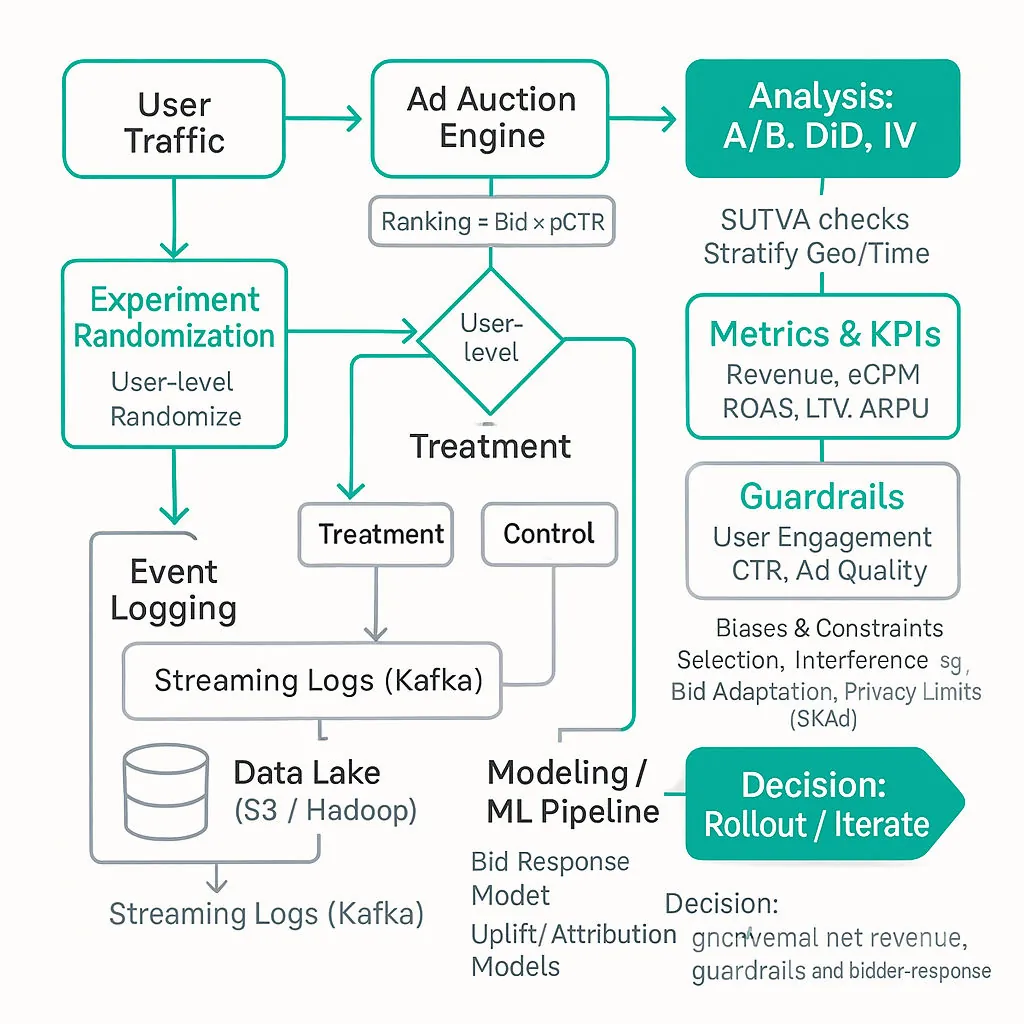
Start by defining primary KPI (incremental net revenue per DAU and advertiser ROI) and guardrail metrics (user engagement, CTR, ad quality). Propose an experiment: user-level randomization with sufficient traffic slices, stratify by geography/time, and log auction-level variables (winning bids, pctr, ad quality, payments). Plan to measure short-term incremental revenue and model long-term bidder response: estimate immediate delta via A/B, then build a dynamic model or run longer rollout to capture bid adaptation and supply effects. If randomization isn't possible, propose an IV leveraging rollout timing or eligibility thresholds.
A common pitfall
The tempting quick answer is "run a simple pre/post uplift on revenue." That ignores seasonality, bidder adaptation, and interference across users/auctions, producing biased estimates. Similarly, optimizing only for short-term revenue can worsen user engagement or advertiser ROI; failing to log auction-level granularity prevents diagnosing why revenue changed.
Further reading
- Kohavi et al., "Trustworthy Online Controlled Experiments" (practical experimentation pitfalls).
- Edelman, Ostrovsky, & Schwarz, "Internet Advertising and the Generalized Second-Price Auction" (auction fundamentals).