Articles · Amazon
Amazon's Bias for Action: What Interviewers Actually Score (With 3 Worked STAR Answers)
What Amazon's Bias for Action principle really tests: one-way vs two-way doors, the follow-up probes interviewers use, and three worked STAR answers.
"Bias for Action" is the Amazon Leadership Principle with the widest gap between how candidates prepare for it and how interviewers score it. Candidates prepare a story about working fast. Interviewers are listening for something narrower: did you classify the decision as reversible before you moved, did you know what a week of waiting would cost, and could you name the result that would have made you undo it. Speed is the surface. Judgment about reversibility is the thing being graded. This guide covers how the principle is scored in the debrief, the follow-up probes you will get, three fully worked STAR answers from engineering situations, and the anti-patterns that sink candidates who are otherwise strong.
Key Takeaways
- Bias for Action is a decision-classification test, not a speed test. Interviewers score whether you told a reversible "two-way door" from an irreversible "one-way door" before acting, and whether you matched your speed to that classification.
- "I gathered more data and got everyone aligned first" is a failing answer for a two-way-door decision, even when the outcome was good. Consensus-seeking on reversible calls reads as indexing on process over outcomes.
- The strongest single signal you can send is a stopping condition: the metric that would have triggered a reversal, and how fast the reversal would have been.
- Expect the inversion probe — "tell me about a time acting quickly backfired." A fast decision that failed cheaply and changed how you work scores higher than a slow decision that happened to succeed.
- Every worked answer needs three numbers: how much of the information you had at decision time (Bezos's ~70% is the benchmark), what waiting cost per week, and how long the rollback took (or would have taken).
Bias for Action is a decision-classification test
Asked at Amazon — Answer Amazon PM Behavioral Questions An Amazon non-technical PM phone screen: three behavioral questions, each followed by two or three probes for detail. The prompt's guidance asks for concise STAR answers that show your personal contribution rather than the team's, back results with metrics, and map to Leadership Principles without reciting principle names.
Notice what that prompt never does: it never says "tell me about your bias for action." The mapping from your story to a principle happens on the interviewer's side, and for Bias for Action the mapping runs on a single axis: reversibility. The framing comes from Jeff Bezos's shareholder letters. Most decisions are two-way doors: if you walk through and dislike what you find, you walk back. A minority are one-way doors — consequential and hard to reverse — and those deserve deliberate, slow, heavily-consulted process. The failure Bezos was naming is treating every decision like a one-way door, which is how large organizations grind to a halt. His 2016 letter adds the number candidates keep hearing quoted back at them: most decisions should be made with around 70% of the information you wish you had. Waiting for 90% means you were probably slow.
The classification, not the velocity, is what the interviewer grades:
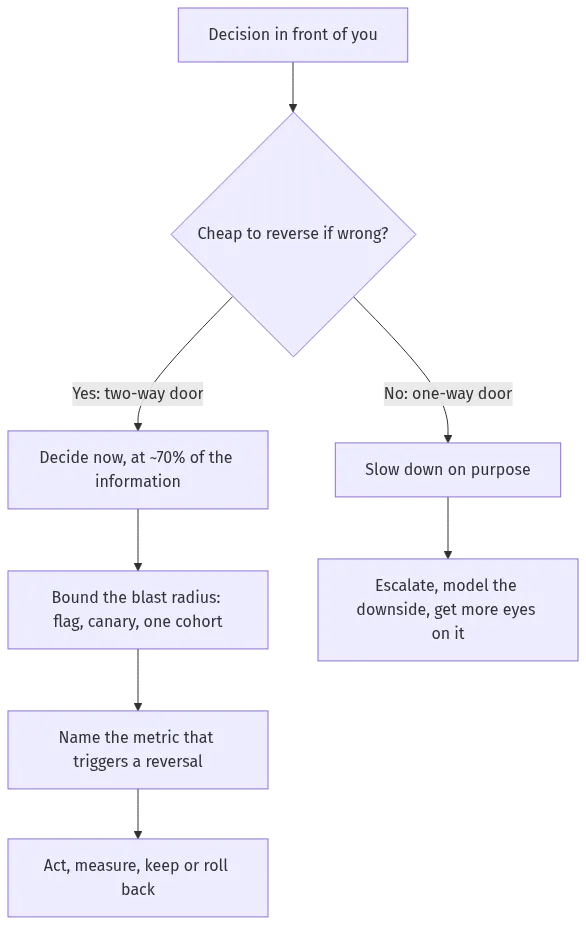
Misclassification is expensive in both directions. Treating two-way doors as one-way produces the six-week analysis for a change a feature flag could have tested in six days. Treating one-way doors as two-way produces the data-deletion script run against production, the contract signed without legal review, the public API shipped without versioning. A candidate who can point to one decision of each kind — one where they moved fast because reversal was cheap, one where they deliberately slowed down — has answered the question behind the question.
One scoping note before going deeper: this page covers a single principle. If you want the full sixteen-principle map and how the loop distributes them across interviewers, we cover that in Amazon Leadership Principles: what they really mean and how Amazon actually scores you. Read that first if the overall structure of the loop is new to you.
How Bias for Action is scored in the debrief
Asked at Amazon — Answer Amazon leadership behaviorals An L6 senior program manager loop where the candidate is expected to bring STAR answers with cross-functional complexity, real ambiguity, and measurable business impact. The prompt explicitly asks candidates to map stories to Leadership Principles naturally instead of name-dropping principles, and to show mechanisms they built rather than one-time heroics.
Each interviewer in an Amazon loop is typically assigned two or three principles to probe, and after the loop they submit written feedback with a vote. The feedback is expected to be evidence-based: detailed notes of what you said, tagged to the principle. That mechanic explains two things candidates find surprising.
First, saying "this demonstrates my bias for action" does nothing for you. The interviewer needs evidence they can paste into feedback, and a self-assigned label is not evidence. The instruction in the L6 prompt above — map stories to principles naturally — is the polite version of "we notice when you're reciting the wiki page."
Second, the follow-up probes are not small talk. They are the interviewer collecting the specific facts the debrief requires. For Bias for Action, expect some subset of these:
- "What did you know at the moment you decided, and what did you wish you knew?"
- "What would waiting two more weeks have cost?"
- "Whose approval did you need — and did you get it before or after you acted?"
- "What was the rollback plan if the metric moved the wrong way?"
- "Walk me through the hour you actually made the call."
- "Tell me about a time acting quickly backfired." (the inversion probe — more on it below)
A story survives these probes only if the decision was genuinely yours and you can reconstruct its inputs. Borrowed stories and team-decision stories collapse under the third probe. If a Bar Raiser is running your loop, assume the probing goes one level deeper than you rehearsed.
Calculated risk vs recklessness: the line interviewers draw
Asked at Amazon — Prioritize Under a Tight Deadline A software engineer prompt about delivering a project on an aggressive timeline without enough people, time, or budget. The interviewer wants to hear what you personally owned, how you decided what to cut or defer, and how you communicated the trade-offs and risks to stakeholders while the clock ran.
Bias for Action's official wording includes "calculated risk taking," and interviewers apply the adjective strictly. The same action — shipping before the analysis was finished — can score as a hire signal or a no-hire signal depending entirely on the scaffolding around it.
| Signal | Calculated risk (hire) | Recklessness (no-hire) |
|---|---|---|
| Blast radius | Bounded before acting: flag, canary, one region, 5% of traffic | Unbounded: straight to 100% of production |
| Reversal | Named trigger metric plus a rollback measured in minutes | "We would have fixed forward" |
| Decision inputs | Can state what was known, unknown, and unknowable at the time | Cannot reconstruct why the call was made |
| Communication | Informed the owners before acting; escalated the irreversible slice | Nobody knew until something broke |
| Cost of delay | Quantified: "every week of waiting cost us X" | Assumed speed was self-evidently good |
The deadline question above is where this table gets tested live. Cutting scope to hit a date is a bias-for-action move. But only if you can say which cut was reversible (deferring the admin UI: two-way door, it ships next sprint) and which was not (skipping the data-migration dry run: one-way door, so you didn't cut it). Candidates who present the cuts as a flat list, without that classification, leave the strongest part of the story on the table.
Note what is not in the hire column: heroics. Working the weekend is not a bias for action. It is sometimes the residue of not having had one earlier.
Why "I waited for alignment" fails the bar
Asked at Amazon — Describe impact, ambiguity, and conflict A hiring-manager conversation for a non-technical Amazon role built around three themes: a time you drove impact, a time you operated through ambiguity, and a time you handled conflict. The prompt asks for ownership, data-driven judgment, and constructive disagreement, with answers concise enough to leave room for follow-ups.
The most common failing answer to an ambiguity prompt goes like this: requirements were unclear, so I set up meetings with all the stakeholders, we built consensus over several weeks, and once everyone was aligned we executed. Candidates tell this story because it feels safe and collaborative. At Amazon it scores poorly, for three specific reasons.
It outsources the decision. The interviewer asked what you did with ambiguity; the answer describes a process that made the ambiguity someone else's problem. There is no decision in the story to grade.
It ignores that Amazon already solved this trade-off, deliberately, in another principle: disagree and commit. Alignment is explicitly not a precondition for action on reversible decisions. An answer that treats it as one signals you haven't understood the operating model you're interviewing into.
And it usually has no clock. Several weeks of alignment-building had a cost (in the checkout example below, a quantifiable one), and the consensus story almost never names it.
Waiting is sometimes the right call, and saying so is a senior signal. But the waiting has to be active and the door has to be one-way. "The schema migration was irreversible, so I spent the week writing a shadow-write comparison instead of shipping" passes. "We formed a working group" does not. If your honest history is full of consensus-driven decisions because that is how your current company works, reframe around the slice you did own: the prototype you built while the working group met, the reversible piece you shipped early to generate the data the group was arguing about in the abstract.
Three worked STAR answers
These are templates drawn from common engineering situations. Swap in your own systems and numbers, but keep the skeleton, because the skeleton is what gets scored: information at decision time, cost of delay, blast-radius bound, reversal trigger, measured result. If the STAR format itself is shaky, start with our STAR method guide and come back.
1. Shipped behind a flag with 70% of the information
Asked at Amazon — Describe using customer data A product manager prompt about using customer data to shape a product decision: how you found the customer problem, which data you used, what you decided, and what happened. The follow-ups ask you to connect the story to several principles at once — Customer Obsession, Think Big, and Bias for Action among them.
Situation. Checkout completion had dropped 2.3% over a quarter. Funnel data narrowed it to the address step but couldn't distinguish two hypotheses: form length, or autocomplete quality on mobile. The analytics team proposed a six-week instrumented study to separate them.
Task. I owned checkout conversion. Six weeks of the current drop-off had a real cost we could estimate from order volume, and I believed we didn't need certainty to start.
Action. I classified the fix as a two-way door in a one-page doc: a rewritten address form with a new autocomplete provider, behind a feature flag, on 5% of mobile traffic, fully reversible in one config push. I set the kill condition up front: if checkout completion in the cohort fell 0.5% below control for two consecutive days, the flag flips off automatically. I told the analytics team we'd run their study in parallel rather than asking their permission to skip it, and I flagged the one irreversible piece — a change to how we stored address history — and cut it from scope so the whole change stayed reversible.
Result. The 5% cohort showed +1.8% completion within nine days. We ramped to 100% over two weeks. The six-week study finished later and confirmed autocomplete quality was the driver, which validated the change we'd already shipped and fed the next iteration. Waiting for the study would have cost roughly a quarter of degraded conversion to learn the same thing.
What the interviewer writes down: classified the door in writing, bounded the blast radius, named the reversal trigger before shipping, informed rather than asked, quantified the cost of waiting, and moved the one irreversible piece out of the fast path. Every probe from the list above has a prepared landing spot.
2. Called the miss early and re-scoped
Asked at Amazon — Recover from a Missed Deadline A software engineer prompt about a deadline you missed or were about to miss: how the commitment was made, when you first saw the risk, how you communicated it, and what recovery you proposed. The hint warns against redefining the deadline after the fact or blaming another team for everything.
This question is usually filed under Earn Trust and Deliver Results, but there is a Bias for Action axis inside it that most candidates miss: the timestamp. When did you act, relative to when you first could have known?
Situation. A service migration committed to a hard date tied to a datacenter contract ending. At the halfway mark, burn-down showed 70% of the work remaining, and that remaining work included the two integrations we'd rated highest-risk.
Task. I was tech lead. The comfortable move was to wait two more sprints for "certainty": maybe velocity would recover. The projection said otherwise — 30% of the work done in 50% of the time puts the straight-line finish about two-thirds of the original timeline past the date, and the hardest work was still ahead of us, not behind us.
Action. I treated the projection as sufficient information and escalated that week, not after the next sprint review. I brought three options with costs attached: cut the two lowest-traffic integrations from launch scope (reversible; they migrate about a month after launch), add two borrowed engineers (cost to another team's roadmap), or slip the date (not actually available, given the contract). I recommended the scope cut and named what would change my mind: if the high-risk integrations came in under estimate, we'd pull one cut item back in.
Result. We shipped the reduced scope on the date and migrated the deferred integrations five weeks later — the plan said a month, and the slip landed on the reversible slice, where slips are cheap. I also changed our estimation process to re-project the finish date weekly instead of at sprint boundaries, so the next early warning would be automatic instead of depending on someone choosing to look.
The bias-for-action content is acting on a projection instead of waiting for the miss to become undeniable. Escalating at the halfway mark with a plan is action; escalating at 95% with an apology is not. The mechanism at the end (weekly re-projection) is what separates an L5 answer from an L6 one: you didn't just recover, you removed the need for heroic recovery next time.
3. Rolled back in 40 minutes and kept the learning
Asked at Amazon — Describe a failure and what you learned A direct failure prompt: the situation and your goal, what went wrong and your role in it, what you did immediately afterward, what you changed to prevent recurrence, and the measurable result after the change.
You need a failure story where the decision process was sound even though the outcome wasn't — because that is exactly what the inversion probe ("tell me about a time moving fast backfired") is fishing for.
Situation. I shipped a cache-layer change on a Thursday afternoon based on staging benchmarks showing a 30% latency win. Staging traffic was replayed from a week-old sample.
Task. Production p99 latency spiked 4x within twenty minutes of rollout. I owned the change and the response.
Action. Rollback took 40 minutes end to end, not because we scrambled but because the rollback path had been rehearsed as part of the release checklist, and the deploy was flagged so the revert was a config change. In the postmortem I traced the gap: the staging traffic sample missed a nightly batch consumer whose access pattern defeated the new eviction policy. I changed our canary policy so cache and storage changes bake through at least one nightly cycle before ramping.
Result. The re-shipped change, canaried through a full 24-hour cycle, delivered a 22% p99 improvement. The 40-minute incident became the argument that got the longer canary window adopted by two sibling teams.
Told this way, a failure passes Bias for Action instead of failing it: the risk was calculated (staging evidence, flag, rehearsed rollback), the reversal was fast because it was prepared, and the learning became a mechanism. If your failure stories still feel dangerous to tell, how to answer "tell me about a time you failed" covers the fuller version of this reframe.
The anti-patterns that sink candidates
Asked at Amazon — Stand by a Disputed Technical Judgment A prompt about a time others believed your technical judgment was wrong and you kept advocating for it: what evidence you had, how you challenged your own assumptions, and how the disagreement was resolved. The hint is blunt — persistence should be proportional to evidence, and you must be able to say what would have made you stop.
That last requirement — what would have made you stop — is the thread connecting most Bias for Action failures. Here are the patterns that come up constantly, roughly ordered by damage:
Retroactive door classification. The candidate acted impulsively, and when probed, labels the decision "a two-way door" after the fact. The test interviewers apply: could you have stated the rollback plan before you shipped? If the reversibility analysis happened during the incident review, it wasn't a calculated risk. It was luck with good PR.
Hero speed. The 2 a.m. hotfix pushed straight to production, nobody informed, no guardrail. Candidates tell this story proudly. It fails the calculated-risk table on three rows at once and usually dings Earn Trust in the same debrief. Speed without a bound is the recklessness column.
Speed without a clock. The story never says what waiting would have cost. If delay was free, acting fast wasn't a bias for action — it was impatience, and the interviewer is left wondering whether you'd have been better off with the extra data. Always price the delay, even roughly.
"We decided." Leadership Principle interviews grade individuals. Every "we" in your Action section will be met with "what did you specifically own?" And if the honest answer is "I attended the meetings," the story is unusable. Pick stories where the decision was yours, even if the scope was small. A reversible call you actually made beats a large decision you watched.
No stopping condition. This is the disputed-judgment prompt's core, and it applies to every fast-action story too. Advocating hard, or acting fast, with no named condition that would reverse you, reads as ego rather than judgment. The fix costs one sentence: "if the canary showed X, we'd have pulled it."
Only success stories. Senior loops routinely include the inversion probe. Arriving with no story where speed burned you signals either low ownership (someone else absorbed your failures) or low self-awareness. Story 3 above is the shape to prepare.